 Kera
What does hair breakage look like? Seven signs, and what each one means
Breakage rarely shows up looking like "breakage". It is short blunt bits in the sink, a ponytail that thins at the bottom, a fuzzy halo at the crown. Here is what each sign looks like, and what it points to.
The short answer
Hair breakage looks like short pieces of hair with no white bulb at either end, usually blunt or frayed, found in your brush, sink or on your clothes. On your head it shows as split or frayed ends, tiny white dots along the strand, a halo of short fuzzy hairs at the crown or hairline, a ponytail that is noticeably thinner at the bottom than at the top, and hair that stays the same length for months even though it is growing. Shed hairs look different: they are full length, with a small pale bulb at the root end.
People search for what breakage looks like because they have already seen something that worried them — hair in the sink, a thinner ponytail, a fuzzy crown in a photo — and they want to know whether it is breakage or something worse. Most of the time you can tell by looking, if you know what to look for.
The first thing to settle is whether the hairs you are finding broke or were shed. That takes thirty seconds and has its own guide, but in short: a shed hair is full length with a tiny pale bulb at the root; a broken one has no bulb, is shorter than your hair, and ends bluntly or in a fray.
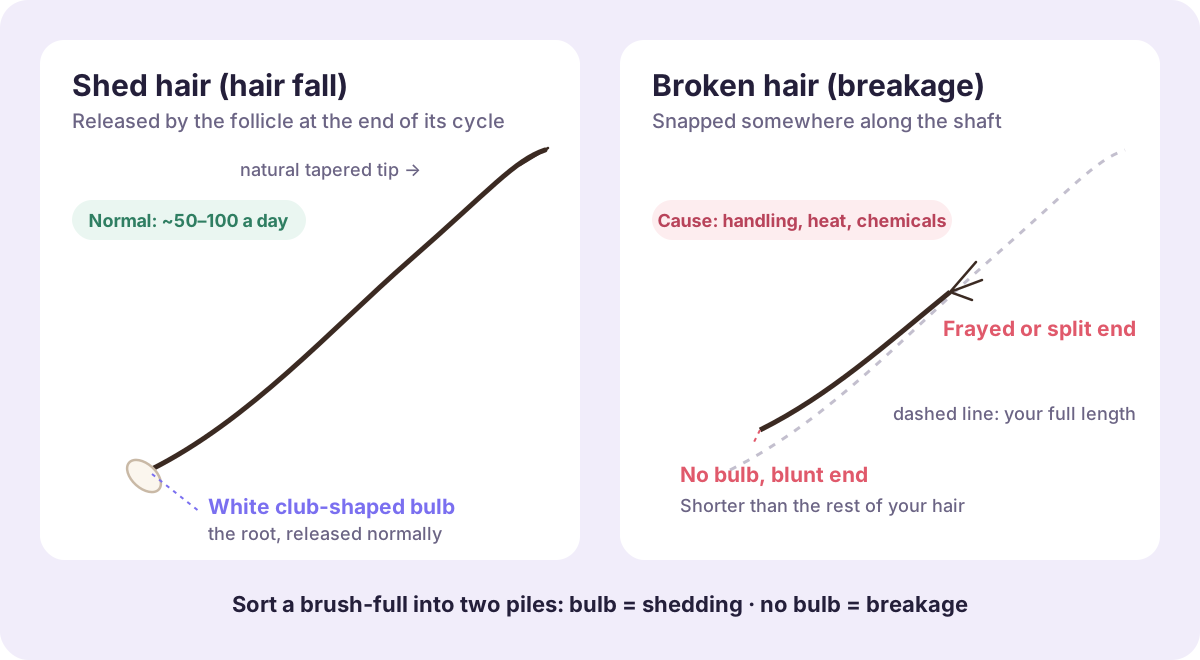
The seven signs of hair breakage
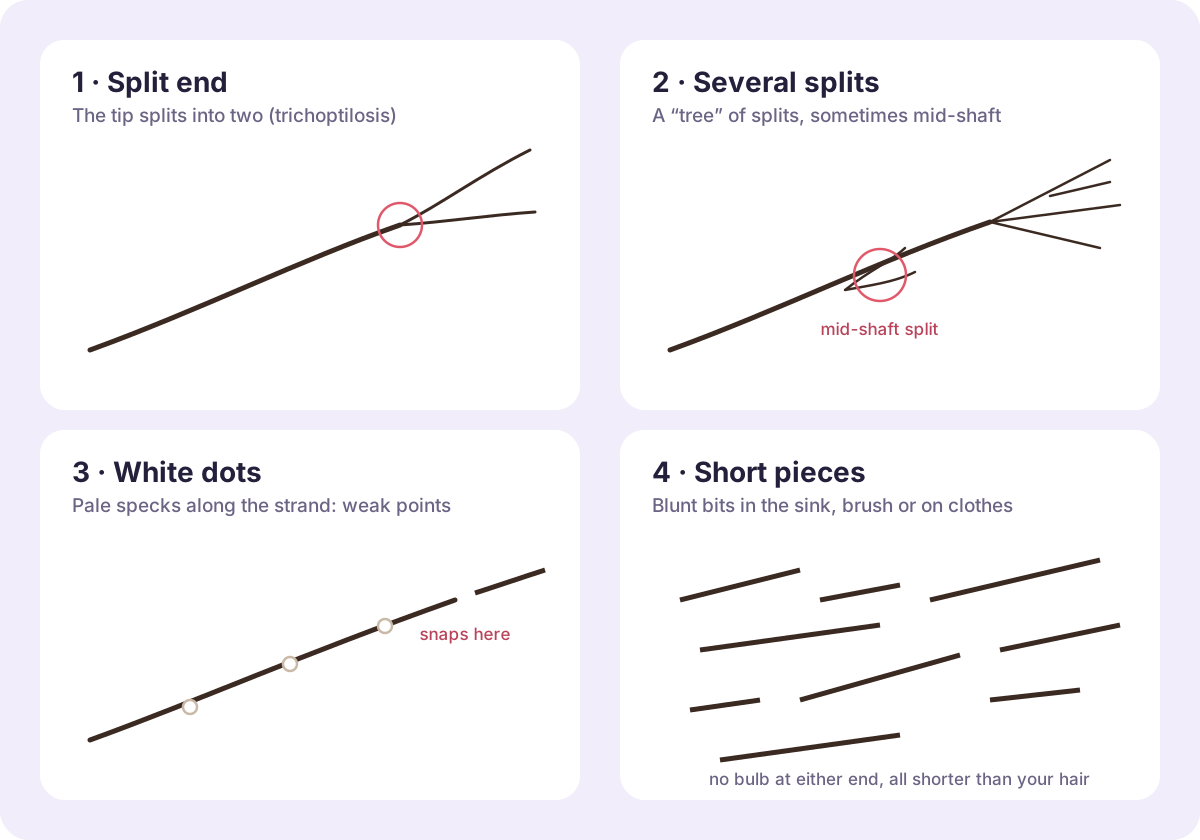
1. Short pieces with no bulb
The most common sign, and the one people mistake for hair loss. You find short lengths of hair — a few centimetres, sometimes less — in your brush, on the bathroom floor, on the shoulders of a dark top. Pick one up and look at both ends: no bulb, and both ends blunt or frayed. The pieces are different lengths, because they snapped at different points.
2. Split and frayed ends
The protective outer layer of the hair, the cuticle, wears away first at the ends, which are the oldest part of your hair. Once it is gone, the inner fibres separate: a single split into two (a "Y"), several splits like the branches of a tree, or an end that looks frayed and see-through. Hold the ends up to a light against a dark background and they are easy to spot. They do not heal — the split ends guide explains why, and what does help.
3. White dots along the strand
Small, pale specks partway along a strand, usually in the lower half. These are points where the fibre has been damaged and splayed, and the strand is about to snap there — if you bend the hair at a dot, it often breaks exactly at that point. They are common after bleaching and heat, and they are often mistaken for dandruff.
4. A halo of short hairs at the crown or hairline
Smooth your hair down and look in the mirror, or at a photo taken from above: a fuzzy halo of short hairs sticking up at the crown, along the part or around the hairline. If the tips are blunt and the lengths vary, it is breakage — usually from brushing, tight styles, or friction against a pillow. If the tips are fine and tapered and the hairs are all a similar length, it is new growth, which is good news.
5. A ponytail that thins at the bottom
Gather your hair into a ponytail and look at it from the side. A healthy ponytail tapers a little towards the ends. One that is dramatically thinner at the bottom than the top, with see-through ends, has lost length to breakage along the way — and the loss is in the lengths, not at the scalp.
6. Hair that stops getting longer
Scalp hair grows at around a centimetre a month. If yours has been the same length for six months without a trim, it is still growing — it is just breaking off at roughly the same rate. This is the quietest sign and the most telling one.
7. Rough lengths that snap while you detangle
Hair that feels rough or straw-like, tangles easily and makes a faint snapping sound when you comb it is breaking as you handle it. Fibres with a damaged cuticle catch on each other, knot, and give way under the comb. Detangling without breakage is the first thing to fix.
Breakage or new growth?
Short hairs are not always bad news. This is the side-by-side that settles it.
| Breakage | New growth | |
|---|---|---|
| The tip | Blunt or frayed | Fine and tapered |
| Where | Scattered through the lengths, the crown, ponytail line | Mostly along the hairline and part |
| Lengths | All different | Similar to each other |
| Feel | Rough, often dry | Soft, often finer than the rest |
| What it means | Something is snapping the fibre | The follicles are producing — keep going |
Where it breaks tells you why
Breakage clusters, and the cluster usually names the cause. At the ends only: age of the fibre plus heat. In a band at ponytail height: the hair tie. A halo at the crown: brushing or friction while you sleep. At the nape: collars and seat backs. Everywhere, with hair that feels rough: chemical damage, most often bleach. The shedding or breakage guide goes through each one, and the fix that goes with it.
What to do next
If what you are seeing fits the signs above, run the four checks in the hair breakage test. They take ten minutes and tell you whether you are dealing with breakage, shedding, or both — and whether the fibre is brittle, over-stretched, or simply worn at the ends.
Then change one thing at a time and watch the same signs for a month. Breakage responds quickly to handling: within a few weeks there are fewer short pieces in the brush, and within a few months the ends start to fill in.
Common questions
What does hair breakage look like on curly or coily hair?
The same signs, but harder to see, because curls hide length. Look at the ends when the hair is stretched or wet: thin, see-through ends and single-strand knots near the tips are the giveaways. Short broken pieces in the shower are often curled, so straighten one between your fingers to check both ends for a bulb.
Is it breakage or new growth?
Look at the tip. New growth has a fine, tapered point and appears mostly along the hairline and part, all at a similar length. Breakage has a blunt or frayed end, appears scattered through the lengths, and the pieces are all different lengths.
Can breakage look like dandruff?
The white dots of breakage can, at a glance. The difference is that dandruff flakes sit on the scalp and slide off a strand when you pinch and pull, while breakage dots are fixed points on the hair shaft itself — the strand often snaps exactly there if you bend it.
How much hair breakage is normal?
Some is unavoidable: hair is a fibre under daily mechanical stress, and a few short pieces after brushing is ordinary. It is a problem when your ends stop gaining length, your ponytail thins at the bottom, or you can see a halo of short broken hairs at the crown.
Does hair breakage grow back?
The follicle is not affected by breakage, so the hair keeps growing from the root. What you lose is length, and it comes back at about a centimetre a month once whatever is snapping it stops.
Kera offers hair-care lifestyle suggestions, not medical advice. It does not diagnose or treat any condition.