 Kera
Hair breakage test: four at-home checks that tell you what is going on
Four quick checks — the bulb test, the stretch test, the ends test and the count test — that tell you whether you are losing hair to breakage or shedding, and what kind of breakage it is.
The short answer
A hair breakage test starts with the bulb check — collect fallen hairs and look at the ends: a small white bulb means shedding, no bulb and a blunt or frayed end means breakage. Then stretch a wet strand gently to test elasticity (snaps at once means brittle; stretches and stays stretched means over-processed), compare the thickness of your ponytail at the top and the bottom, and count what you lose for a week. Together they tell you whether you are dealing with breakage, shedding or both, and what kind of breakage it is.
There is a lot of advice about breakage and very little about how to tell whether you have it. These four checks take about ten minutes together, need nothing more than a sheet of paper and a mirror, and turn "my hair seems worse" into something you can act on.
Do them in order. The first one decides whether the rest are worth doing.
Test 1: the bulb test — breakage or shedding?
Gather the hairs from your brush, the shower drain and your pillow. Lay a few on a sheet of paper that contrasts with your hair colour, and look at both ends of each one.
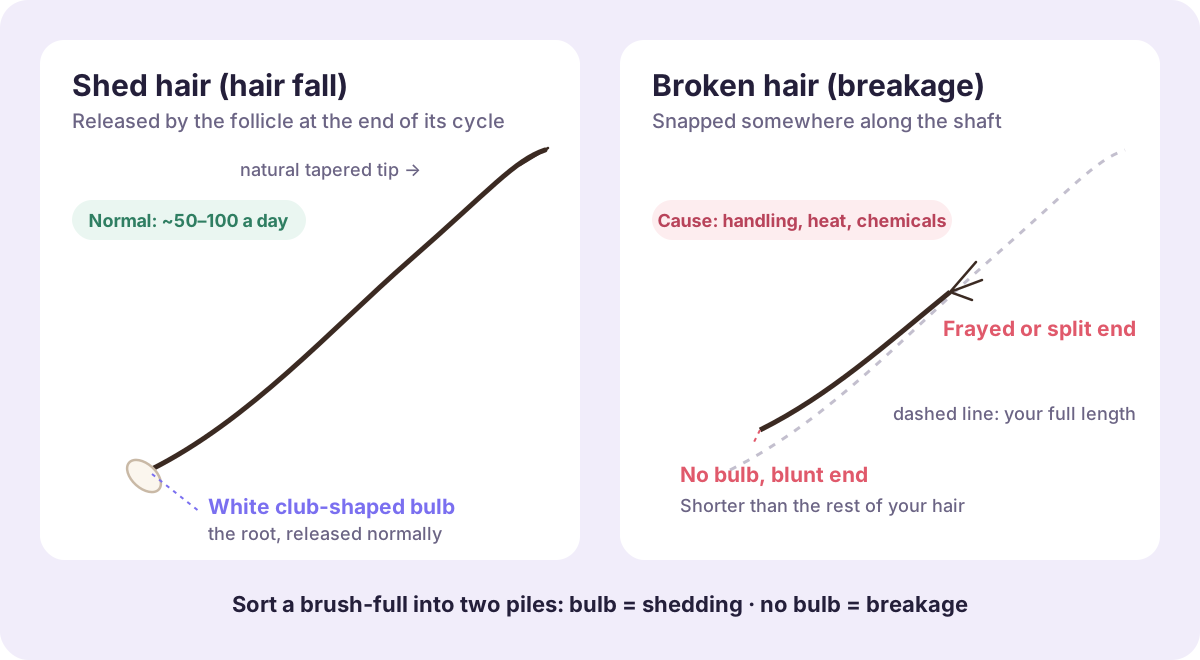
- A small pale bulb at one end, full length: shedding. The follicle released the hair at the end of its growth cycle. Up to about 100 a day is normal.
- No bulb, blunt or frayed ends, shorter than your hair: breakage. The strand snapped somewhere along its length.
- Both: very common. Sort them into two piles; the bigger pile is where to spend your effort.
If almost everything you find has a bulb, the rest of this test is not about you — the question is why you are shedding, and the shedding or breakage guide covers that.
Test 2: the stretch test — what kind of breakage?
Take one of the broken strands, or one that has just come out. Wet it, hold one end in each hand, and pull gently and slowly.
| What happens | What it usually means | Where to start |
|---|---|---|
| Stretches a little, then springs back | Healthy elasticity | Look at handling and tools |
| Snaps almost at once | Brittle, dry, often lacking moisture or over-proteined | Moisture and gentler drying |
| Stretches a long way and stays stretched, feels gummy | Over-processed or over-softened, common after bleach | Protein, and a break from chemical work |
Elasticity is the single best indicator of how a fibre will behave under a comb. The protein and moisture guide explains how to rebalance in either direction.
Test 3: the ends test — where is it breaking?
Put your hair in a ponytail and look at it side-on in a mirror. Then let it down, take a section from the back, and hold the ends up to a window.
- A ponytail much thinner at the bottom than the top, with see-through ends, means length is being lost along the way.
- Split, frayed or white-dotted ends mean damage concentrated at the oldest part of the hair. What hair breakage looks like shows each sign.
- A band of short hairs at the same height means something mechanical at that point — usually a hair tie.
Test 4: the count test — how much?
For seven days, collect every hair from your brush and drain into an envelope, and keep breakage and shed hairs separate. Divide each pile by seven.
One day tells you nothing — a wash day after four days off releases far more than a daily-wash day. A week gives you a baseline. Repeat it a month later, on the same day of your wash cycle, and the comparison is real data.
Reading your results
| Bulb test | Stretch test | Ends test | What you are looking at |
|---|---|---|---|
| Mostly no bulb | Snaps quickly | Dry, split ends | Brittle breakage: moisture, less heat, gentler handling |
| Mostly no bulb | Over-stretches | Rough lengths everywhere | Chemical or over-processed breakage: protein, pause bleaching |
| Mostly no bulb | Normal | A band, or the crown only | Mechanical breakage: ties, brushes, pillow friction |
| Mostly bulbs | Normal | Ends fine | Shedding: look for a trigger two to three months back |
Common questions
What is the hair stretch test?
Take a single strand that has just come out, wet it, hold one end in each hand and pull gently. Healthy hair stretches a little and springs back. Hair that snaps almost immediately is brittle; hair that stretches a long way and stays stretched, or feels gummy, is over-processed or over-softened.
How do I know if my hair is breaking or falling out?
Look at the ends of the hairs you find. A small white bulb at one end means the hair fell out at the root as part of its normal cycle. No bulb, a blunt or frayed end and a shorter length mean the hair broke along the shaft.
Is there a test for hair breakage at a salon or doctor?
A trichologist or dermatologist can look at the hair under magnification (trichoscopy) and do a gentle pull test at the scalp to see how many hairs release. That is worth doing if the at-home checks point to shedding, or if you see patches or scalp symptoms.
How often should I repeat the breakage test?
The count test is most useful repeated monthly, on the same day of your wash cycle. The others are worth repeating after you change something — a new product, a new tool, a trim — to see whether it made a difference.
Kera offers hair-care lifestyle suggestions, not medical advice. It does not diagnose or treat any condition.